Creep test

This test is designed to verify the long-term creep of a conductor or wire when holding a fixed tension. Creep results in further sagging after installation. For overhead lines, excessive sagging may result in power outages due to violation of electrical clearance distances, line breakage, tower or pole damage or even collapse. It is therefore critical to correctly estimate the creep that will occur over time. In the case of a railway contact wire sagging may lead to a bad contact between the pantograph and the contact wire. It is therefore critical to correctly estimate the creep that will occur over time.

Creep tests can be performed on stranded conductors, messenger wires and contact wires. Our lab is accredited for the common standard IEC61395.
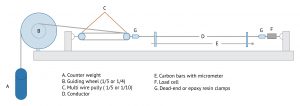

  • Up to 3 creep tests can be run simultaneously.
  • Data is digitally collected, ensuring high accuracy.
  • Realistic simulations are possible thanks to climatised room and load controlled gravity and auto tensioning.
  • Temperature regulation: a transformer with rectifier is connected to the sample for testing at high temperature. The transformer is controlled via temperature feedback.
  • Our lab offers meticulous sample preparation.
  • It is possible to combine creep testing with heat testing, with currents up to 2000A.
  • The conductor/wire is mounted in a fitting on both sides (one fixed point and one movable point);
  • Tension is added by counter weights;
  • This set-up is held for a longer span of time (usually 1000 hours);
  • During this time span the elongation of the conductor/wire is measured versus time and applied force;
  • This result lead to the definition of the specific creep formula for the tested conductor/wire;
  • A full report is prepared including test object data, test description, set-up, procedure results and conclusions.
  • A creep test can be performed at elevated temperature.