- Lamifil has a unique indoor sag temperature testing facility allowing span lengths of 108 m.
- Currents of up to 4000A and up to 10 tons of force can be handled.
- All sag temperature tests are fully accredited.
- Lamifil has unique in-house expertise to interpret results.
- Our lab has experience with all conductor types (HTLS, GAP,…).
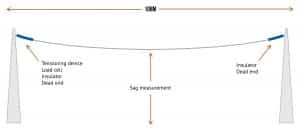
- A realistic simulation is set up by mounting a conductor between two dead-ends. The dead-ends are fixed between two towers with a span length of 108 m;
- Current is applied to the conductor (up to 4000A), causing the conductor to heat and sag;
- Both temperature and the resulting sag are measured throughout time, respectively by a data logger and a string potentiometer;
- Measurements are plotted in a sag/temperature curve and are subsequently compared to sag calculations;
- A full report is prepared including test object data, test description, set-up, procedure results and conclusions.